

Loading article body...
Climate Tech & Resilience• August 6, 2026
Can AI Actually Fix the Messy Data in Your Carbon Accounting Software?
S
Written by Skylimate Green Team
Log in to unlock personalised tool recommendations and AI solar matching.
Field engineers and sustainability officers still struggle with fragmented data streams during the shift from manual spreadsheets to automated SaaS platforms. This transition often replaces one set of errors with another, as legacy data formats clash with rigid software requirements. Most firms view AI as a total replacement for data entry, yet this misconception creates significant audit risks. True efficiency emerges when teams treat AI as a precision instrument for pattern recognition, gap-filling, and anomaly detection rather than a magic wand.
Correct application of these tools reduces manual labor by up to 70% by automating the mapping of unstructured utility bills and fuel receipts. However, the post-2025 regulatory era demands absolute transparency. To satisfy 2026 audit standards, engineers must maintain strict human oversight over every AI-generated adjustment. This hybrid approach ensures that carbon accounting software produces empirical results that withstand the scrutiny of next-gen ecological baselines and post-COP30 frameworks.
Enterprise carbon data suffers from inherent structural flaws because most companies pull information from legacy systems never designed for environmental reporting. ERPs and procurement software track financial costs, not carbon intensity, leaving a massive gap between a line-item expense and its actual atmospheric impact. This disconnect forces sustainability teams to rely on fragmented data silos where inconsistent units of measure and missing metadata create "dark data" pockets. These systemic failures lead to calculation errors that compromise the integrity of an entire corporate footprint. In the post-2025 regulatory era, these inaccuracies no longer represent simple clerical errors; they constitute significant compliance risks under new mandatory disclosure regimes.
Mapping thousands of localized emission factors to a global supply chain creates a logistical nightmare for field engineers. The EPA's 2026 GHG Emission Factors Hub update and the UK DEFRA 2026 conversion factors introduce high-granularity data that requires precise alignment with operational activities. When a company operates across multiple jurisdictions, it faces severe temporal mismatches, as different agencies release updates on staggered schedules. This forces teams to mix 2025 and 2026 factors within a single reporting cycle. Furthermore, regional variance complicates the math; a kilowatt-hour of electricity in a coal-heavy grid carries a vastly different carbon weight than one from a hydro-dominant region, yet legacy software often defaults to global averages. Finally, unit incompatibility demands flawless mapping to convert disparate metrics—such as therms, liters, and kilograms—into CO2 equivalents without compounding errors.
The reliance on secondary data creates a systemic vulnerability in corporate carbon footprints. According to CDP's supply chain reporting, a large share of Tier-2 and Tier-3 suppliers still fail to provide primary activity data. This failure forces sustainability teams to substitute actual measurements with industry averages or spend-based estimates, which often mask the true carbon intensity of the supply chain.
This primary data gap introduces severe estimation drift, as spend-based proxies assume a linear relationship between cost and carbon while ignoring supplier-specific efficiency gains. The lack of Tier-3 transparency also creates visibility blind spots, preventing firms from identifying high-emission hotspots deep within their procurement network. Ultimately, reliance on these estimates fails the rigorous transparency requirements of modern compliance regimes, as auditors now demand empirical evidence over theoretical proxies.
Machine learning transforms carbon accounting from a reactive exercise into a proactive data pipeline. Rather than relying on static rules, ML algorithms employ probabilistic modeling to identify patterns within massive, unstructured datasets. These systems utilize supervised learning to recognize specific data signatures—such as fuel consumption patterns or utility billing cycles—and unsupervised learning to flag anomalies that deviate from historical baselines. By analyzing the relationship between disparate data points, ML identifies missing values and suggests the most probable emission factor based on the operational context. This mechanical shift moves the burden of data scrubbing from the field engineer to the algorithm, allowing humans to focus on validation rather than manual extraction.
Unstructured PDF invoices and receipts represent the primary bottleneck in carbon data collection. Gartner's Market Guide for Carbon Accounting and Management Software notes that Natural Language Processing (NLP) tools now automate the extraction of detailed data from these documents. Instead of simple optical character recognition, NLP understands the semantic context of a document to isolate critical variables. This allows the system to execute several high-precision tasks:
This automation drastically reduces manual data entry and minimizes human transcription errors. By converting raw text into structured data, NLP ensures that the input phase of the carbon accounting process meets the rigorous precision required by 2026 compliance mandates.
Data gaps and erratic spikes often compromise the integrity of carbon reports. To combat this, ML models use historical baselines to identify statistical anomalies and predict missing values, following the approach set out in ISO/TS 14064-4:2025, new guidance for applying ISO 14064-1 to data quality and uncertainty. These models establish a "normal" operational signature for every facility. When the system detects a sudden 400% spike in electricity usage, it flags the entry as a potential error rather than an actual emission increase. This process prevents skewed results by distinguishing between genuine operational surges and clerical mistakes. The software then prompts the field engineer to verify the data point, ensuring the final report remains empirical.
When monthly data points vanish due to supplier delays, the ML model employs predictive gap-filling. It analyzes seasonal trends and historical consumption to estimate the missing value with a calculated confidence interval. This approach follows the uncertainty guidance set out in ISO/TS 14064-4:2025. By quantifying the margin of error for every predicted value, the system maintains the transparency required for 2026 audit standards.
AI does not possess an innate understanding of thermodynamics or chemical engineering; it recognizes patterns in data. This fundamental limitation creates a dangerous boundary where probabilistic guesses replace empirical measurements. When a model "fills a gap," it generates a statistical likelihood, not a physical fact. If engineers trust these outputs without verification, they risk baking systemic biases into their environmental disclosures. This reliance on algorithmic intuition over physical evidence creates a fragility in the reporting chain. In the post-2025 regulatory era, a "probable" number does not satisfy legal requirements. The boundary of AI ends where the requirement for absolute traceability begins.
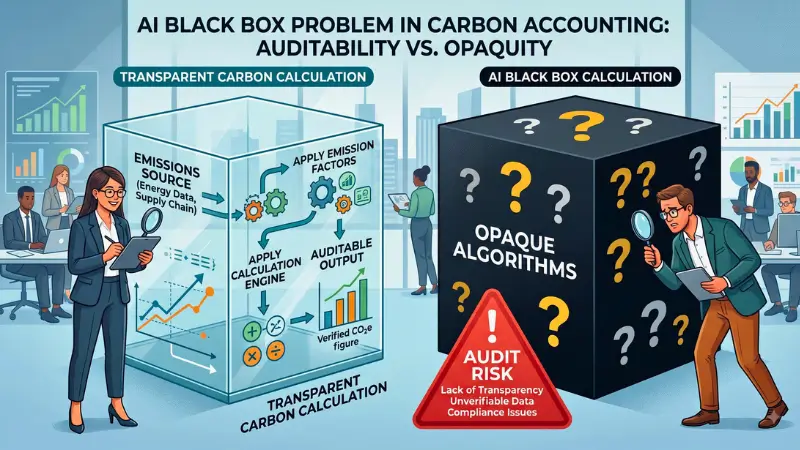
The "black box" nature of deep learning creates a direct conflict with the transparency requirements of modern carbon audits. There is a growing tension between algorithmic efficiency and the need for a clear audit trail. Third-party auditors demand a transparent calculation methodology—a step-by-step path from the raw invoice to the final CO2 equivalent. However, complex ML models often arrive at emissions figures through thousands of weighted neurons, making the exact logic invisible to the human eye. This lack of explainability poses several critical risks:
Without a transparent bridge between the AI's output and the underlying physics, firms face significant liability. To survive a 2026 audit, engineers must implement "human-in-the-loop" systems that force the AI to cite its sources for every adjustment.
The promise of automated carbon accounting collapses when generative AI models encounter ambiguous data. Without strict guardrails, these models can produce incorrect emission factors or misread critical unit conversions. This happens when a model prioritizes linguistic probability over mathematical accuracy. For example, an AI might confidently assign a standard diesel emission factor to a specialized biofuel because the document's phrasing resembles typical diesel invoices. Such errors trigger the "garbage-in, garbage-out" reality of algorithmic tracking. If the input data contains noise or the model lacks a grounding truth, the resulting carbon footprint becomes a work of fiction rather than a technical report.
The risks manifest in several high-impact ways:
These errors render a report useless under 2026 compliance mandates. To fix this, field engineers must implement hard-coded validation layers that override AI suggestions whenever they deviate from established physical constants.
The legal landscape for carbon reporting shifted fundamentally in the post-2025 regulatory era. Regulators no longer view AI-generated data as a convenient shortcut, but as a potential source of systemic risk. Under 2026 compliance mandates, the responsibility for data accuracy rests solely with the human signatory, regardless of the software used. This means that "the AI did it" provides zero legal protection during a government audit. Firms must now prove that their automated pipelines include rigorous verification layers and a complete lineage of every data transformation. Failure to document the logic behind an algorithmic adjustment now triggers severe penalties. The legal reality is simple: automation increases speed, but it also increases the burden of proof for the engineer.
International verification standards now demand a careful approach to how firms handle missing or estimated data. ISO/TS 14064-4:2025, new guidance for applying ISO 14064-1, calls for a formal justification process for any AI-driven imputation, covering both data uncertainty and bias. Accepting an AI's predicted value as absolute truth goes against this guidance. Instead, engineers must treat every algorithmic fill as a hypothesis that requires a documented confidence interval. To meet these international verification standards, teams must implement the following protocols:
By transforming AI outputs from "facts" into "justified estimates," companies align their reporting with next-gen ecological baselines. This level of transparency ensures that the final carbon footprint withstands the scrutiny of third-party verifiers and post-COP30 frameworks.
The regulatory picture shifted in 2026. The SEC proposed to fully withdraw its Climate-Related Disclosure Rule in May 2026, after pausing its legal defense the year before, so federal enforcement of climate disclosure in the US is currently on hold. That does not remove the pressure on carbon data, though. The EU CSRD still applies to large companies, though its 2026 Omnibus update narrowed the mandatory scope to firms with over €450 million in EU turnover. State rules, including California's SB 253, are also filling the gap left open at the federal level. Under these regimes, auditors do not simply check the final numbers; they look at the process that generated Scope 1 and Scope 2 data, including how the AI arrived at its results.
Auditors trace a single emission figure back through the AI's processing layers to the original raw utility bill to check for black box distortions. EU and state regulators also require proof that the software applied the most current regional factors rather than outdated defaults. Firms must also show they have internal controls to catch AI errors before the data reaches the final disclosure.
Procuring carbon accounting software in 2026 requires a shift from evaluating "features" to auditing "methodologies." Most vendors market their AI as a seamless black box, but this opacity creates a liability for the end-user. Buyers must move beyond the demo phase and test the software with their own messiest legacy data. A successful evaluation requires a pilot program where engineers attempt to reverse-engineer the AI's decisions.
If the software cannot explain why it chose a specific emission factor for a complex line item, it fails the 2026 compliance test. The goal is to identify whether the tool provides a genuine audit trail or merely a polished dashboard. True operational value lies in the software's ability to expose its own logic for human verification.
The risk of algorithmic error means data lineage needs full attention. The GHG Protocol's data quality guidance sets a similar standard for corporate reporting: transparency must exist at every stage of the data journey. Buyers must demand platforms that provide a visible, clickable path from the final CO2e calculation back to the raw invoice. This "lineage" ensures that no data point exists in isolation and that every transformation remains traceable. A compliant audit trail must include the following technical markers:
Without this level of detail, a platform remains merely a calculator with a fancy interface. By enforcing strict lineage requirements, firms ensure their data aligns with post-COP30 frameworks and withstands the most rigorous third-party audits.
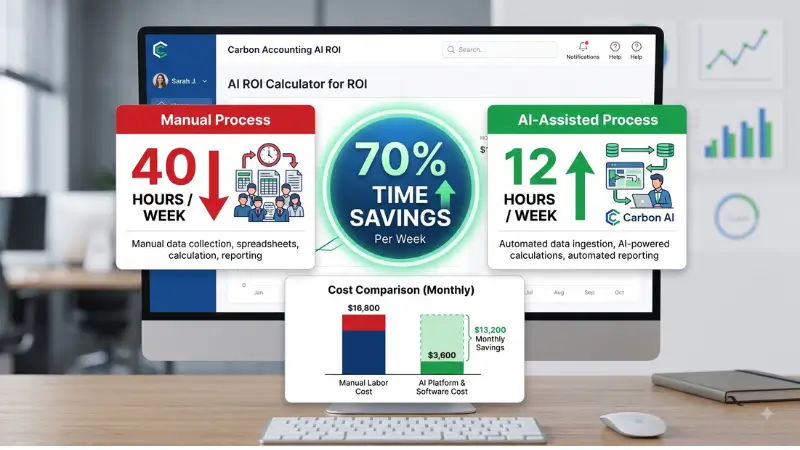
Buyers must calculate the true ROI of AI features by measuring the reduction in manual data-entry hours against the premium software tier cost. A successful platform reduces the time spent on Scope 3 Category 1 data collection by up to 70%. This efficiency allows data stewards to focus on double materiality assessments and strategic decarbonization rather than manual transcription.
AI does not replace the carbon accountant; it forces the accountant to become an auditor. The transition to automated SaaS platforms reduces manual data entry but increases the legal burden of verification. In the post-2025 regulatory era, trusting a "black box" algorithm constitutes a critical compliance failure. Decision-makers must prioritize a hybrid operational model to survive 2026 audit cycles. This requires a shift from passive software adoption to active algorithmic governance.
To secure a compliant carbon footprint, execute these three mandates:
The competitive advantage in 2026 belongs to firms that treat AI as a high-speed filter, not a final answer. By anchoring algorithmic speed in empirical evidence, enterprises transform their carbon accounting from a liability into a verified strategic asset.