

Loading article body...
Climate Tech & Resilience• September 7, 2026
Does Carbon Assurance Close the 32% Reporting Gap?
S
Written by Skylimate Green Team
Log in to unlock personalised tool recommendations and AI solar matching.
Reported emissions often diverge from reality. Recent data reveals a 32% average gap between reported figures and expected emissions levels. This discrepancy forces B2B buyers and environmental auditors to question the integrity of corporate climate claims in the post-COP30 era. They now demand proof that third-party verification actually cleans up the books.
Field engineers and CSOs must determine if paying for assurance yields genuine accuracy or merely a legal shield. The 2026 rulebook mandates higher precision to avoid steep non-compliance penalties. This shift turns carbon accounting from a marketing exercise into a financial requirement. Stakeholders now scrutinize the delta between production volume and carbon output to spot manipulation.
Detailed analysis of these discrepancies appears in this SSRN preprint, which examines the efficacy of external verification.
Researchers quantified carbon accounting quality by isolating abnormal emissions. They compared actual reported data against a baseline of expected emissions built from production volume.
This method identifies measurement errors or intentional under-reporting. By analyzing these deviations, the study determines whether external assurance shrinks the gap between reported and actual footprints. The focus stays on the reliability of Scope 1 and Scope 2 disclosures under 2026 compliance mandates.
The research model operates on a simple premise: carbon emissions typically track production volume. When a company increases output, its footprint grows proportionally. Large deviations from this trend signal measurement problems or reporting failures.
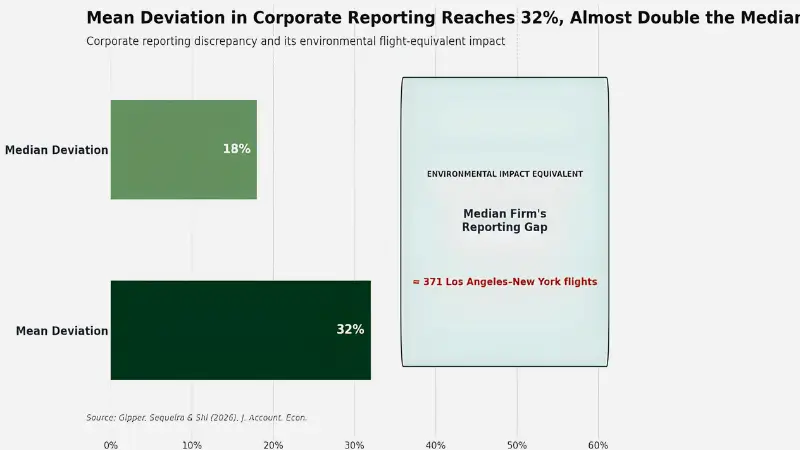
The data shows how wide the error runs. Reported emissions deviate from expected levels by 32% on average and 18% at the median (Gipper, Sequeira & Shi, 2026). To visualize that gap, the median firm's reporting error equals roughly 371 Los Angeles–New York flights (Gipper, Sequeira & Shi, 2026).
Assured reports carry smaller deviations than unassured ones. Such discrepancies undermine CDP disclosures and compromise Scope 1 and Scope 2 verification. These gaps prove that without external checks, internal accounting often misses significant emission sources.
External verification directly increases reporting quality, per the full study on ScienceDirect. The impact appears strongest for companies with weak internal systems and those purchasing reasonable assurance. These firms show the largest reduction in reporting gaps after hiring third-party auditors.
Assured companies omit fewer emission sources from their totals. However, they also file more revisions to their historical data. These corrections signal a shift toward accuracy rather than a failure of the system.
The EU NFRD framework provided a causal lift: three member states mandated assurance, and covered firms improved their carbon accounting quality after the rule took effect. This regulatory pressure ensures verification leads to actual data improvement rather than a rubber stamp.

The current verification market rests on low-stakes checks. Non-financial assurors handle 80% of all carbon audits, often lacking the training of traditional financial auditors. Furthermore, over 90% of engagements provide only limited assurance, a low bar for accuracy. This creates a "checkbox risk" where companies pay roughly $15,000 for a certificate that misses major errors. Worse, 65% of firms skip assurance in some years to cut costs, leaving gaps in their longitudinal data.
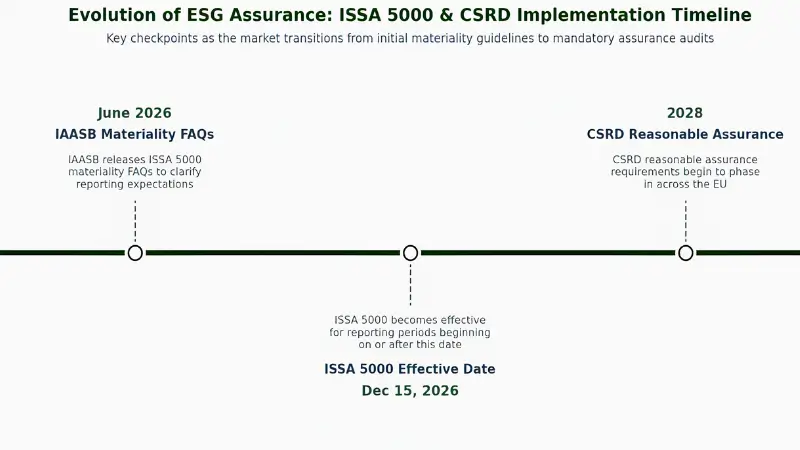
This era of thin verification ends with the arrival of strict 2026 compliance mandates. The IAASB activates ISSA 5000 for reporting periods beginning December 15, 2026, establishing a global standard for sustainability assurance. This standard replaces vague guidelines with precise, audit-grade requirements. Simultaneously, the CSRD pushes the market toward reasonable assurance, with requirements phasing in by 2028.
On September 1, 2026, CARB opened its public intake portal for SB 253 submissions, giving covered companies a live filing channel two months ahead of the November 10 deadline (Watershed compliance guide).
Reasonable assurance requires auditors to gather proactive evidence rather than simply reviewing provided spreadsheets. This shift closes the "limited" loophole and forces companies to prove their data accuracy. Field engineers must now prepare for deeper scrutiny of primary data sources.
The move from limited to reasonable assurance turns the auditor from a passive reviewer into an active investigator. Companies that rely on cheap, non-financial assurors now face significant liability under these new baselines.
Corporate Sustainability Officers and B2B buyers must shift strategy to survive the post-2025 regulatory era. First, procure external assurance early in the reporting cycle rather than treating it as a pre-audit cleanup. Early verification identifies systemic gaps before they become legal liabilities.
Second, request reasonable-level scope for high-risk emission sources whenever the budget allows. This higher standard provides the only genuine defense against greenwashing accusations.
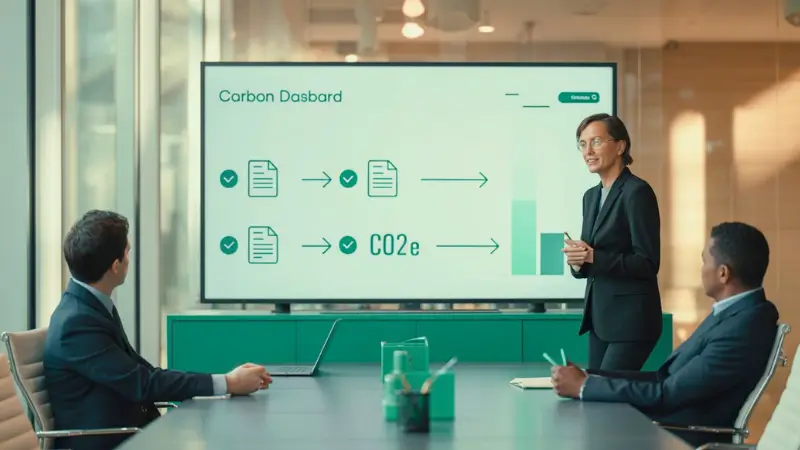
Third, pair these audits with audit-ready software to automate data lineage. Tools like Persefoni and Normative reduce the manual labor of evidence collection. For a full breakdown of the current tech stack, see our 6 Best Carbon Accounting Tools for 2026, and read how AI handles messy input data before assurance begins. Software ensures ESG assurance providers spend time analyzing data rather than hunting for missing spreadsheets.
Operational resilience also runs through resource streams — pair your carbon program with our Top 11 Waste Management Tools for 2026 to close the waste-side data gap before assurance.
Fourth, view carbon emissions revisions as health signals. A company that corrects its historical data demonstrates a commitment to accuracy and a functioning internal control system. Frequent, small revisions often signal a more honest accounting process than a static, perfect record.
Finally, maintain high vigilance regarding manipulation risks. Research indicates that firms underreport emissions following public controversies to regain investor trust. Buyers should scrutinize reports from companies currently facing environmental litigation or PR crises.
These firms possess a higher incentive to hide abnormal emissions. Rigorous verification acts as the only reliable filter against these intentional distortions. By implementing these five steps, CSOs turn carbon accounting from a risk center into a competitive advantage.
External verification upgrades carbon accounting from a vague estimate into a reliable business metric. The 32% gap in unassured reports proves that internal systems alone fail to capture the full climate footprint. While limited assurance offered a thin shield in the past, the shift toward reasonable assurance and ISSA 5000 demands absolute precision.
CSOs who embrace rigorous verification and audit-ready software now avoid the liabilities of the post-2025 regulatory era. The same verification logic applies to nature-based credits — see How Tree-Planting Projects Are Verified? 2026 Guide. Accuracy provides the only sustainable path for B2B buyers and environmental organizations.
Stop guessing your impact and start proving it. Visit our Climate Tech Hub for more technical guides and implementation frameworks.