

Loading article body...
Solar and Energy Posts• September 13, 2026
Solar Panel Recycling in 2026- What Happens to Dead Modules
S
Written by Skylimate Green Team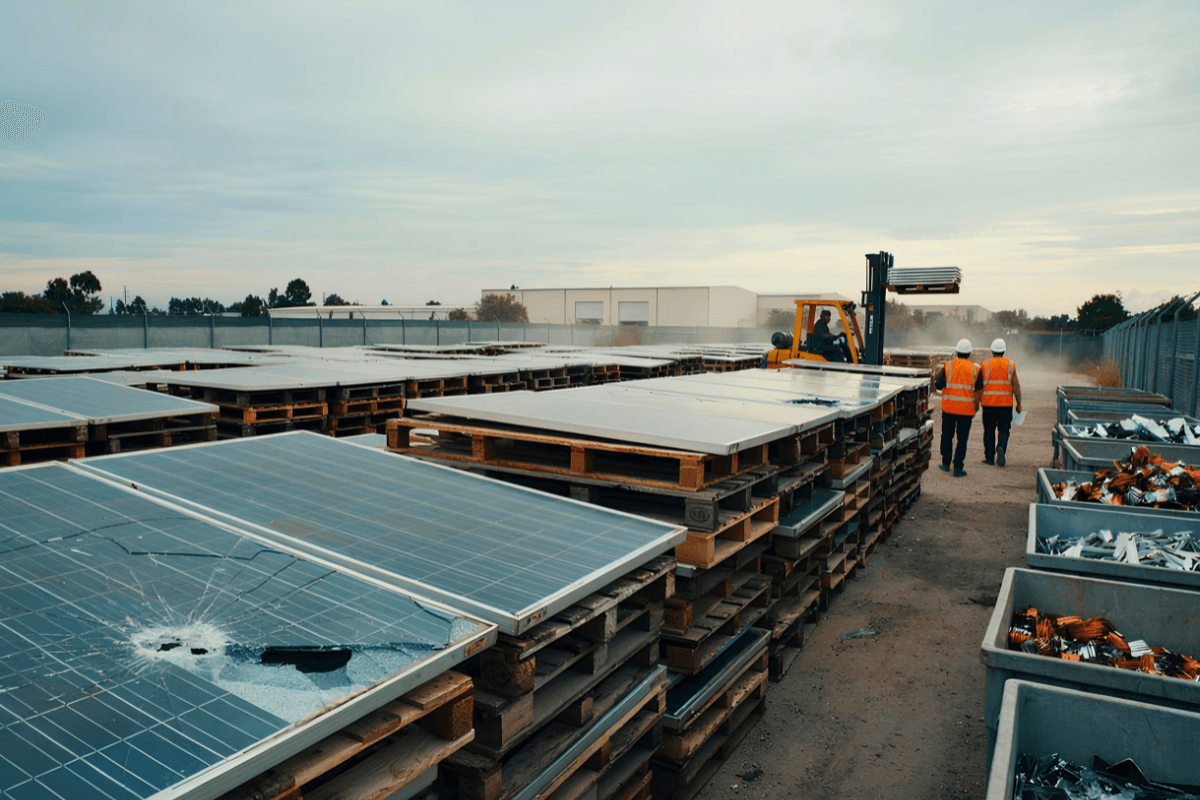
Log in to unlock personalised tool recommendations and AI solar matching.
Landfills currently swallow 90% of retired US panels. This failure creates a mounting crisis as the first generation of utility-scale arrays hits retirement. New 2026 regulations now demand a shift from disposal to recovery, and installers must adapt quickly or face penalties.
Modern recovery facilities target the glass, aluminum, and silicon within end-of-life solar panels using advanced techniques. These processes recover 95% of semiconductor materials, feeding them back into the domestic supply chain to reduce reliance on foreign raw minerals. This circular shift transforms a waste stream into a strategic resource reserve. Operators who ignore these standards risk heavy fines and lost certifications. For a complete list of certified recovery partners and regional compliance standards, visit our solar directory hub.
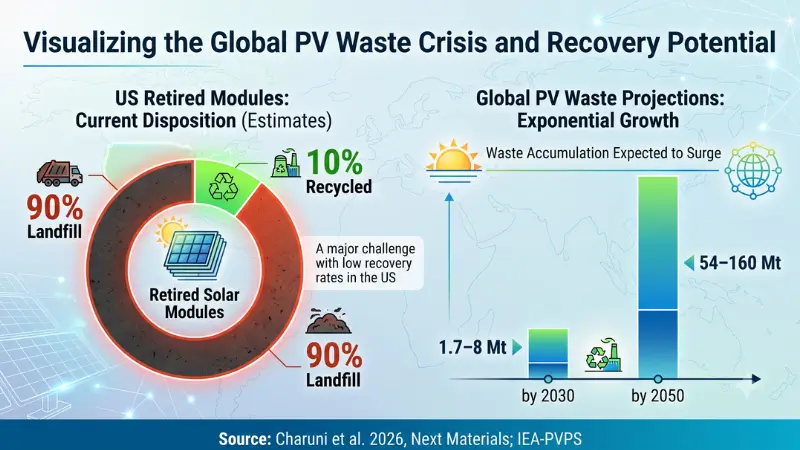
The global energy transition generates a secondary crisis of decommissioned hardware. Global projections indicate a surge in waste, reaching 1.7 to 8 million tons by 2030 and skyrocketing to 54 to 160 million tons by 2050 Charuni et al., 2026. This volume threatens to overwhelm existing waste management infrastructure and contaminate soil with heavy metals. The US situation remains particularly dire, as landfills claim 90% of retired modules while only 10% undergo professional recovery EPA Solar Recycling Guide.
The urgency of PV module recycling stems from the toxicity and value of the materials involved. Improper solar panel disposal releases lead and cadmium into groundwater, violating environmental standards. Beyond the toxicity, the loss of high-purity silicon and silver represents a massive economic leak. Current regulations treat these modules as hazardous waste rather than inert trash. Field engineers must implement strict chain-of-custody protocols to avoid the legal pitfalls of improper disposal. Failure to adopt recovery standards directly undermines carbon-neutral goals.
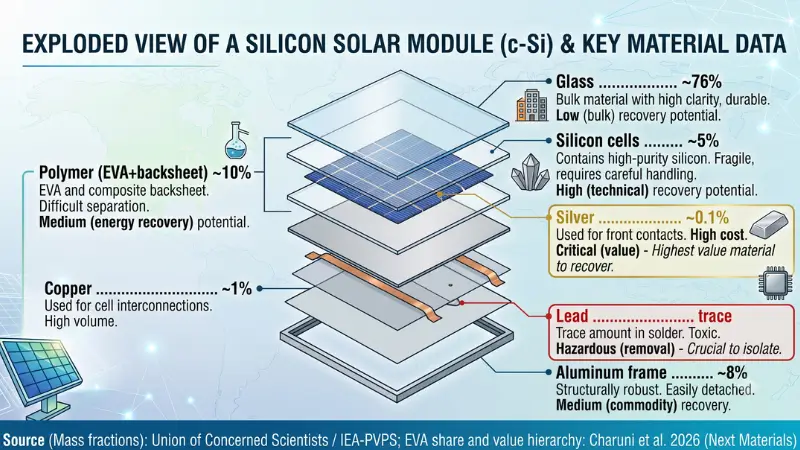
Recovering high-value materials requires a precise understanding of module composition. Most panels consist of low-value bulk materials and high-value trace elements. While glass and aluminum dominate the physical mass, the economic value concentrates in the semiconductor layer. Prioritizing extraction of specific elements ensures project profitability and regulatory compliance.
The following breakdown details the material composition of a standard decommissioned module:
| Material | Mass Percentage | Recovery Priority |
|---|---|---|
| Glass | 75% | Low (Bulk) |
| Polymers | 10% | Medium (energy recovery) |
| Aluminum Frame | 8% | Medium (Commodity) |
| Silicon Cells | 5% | High (Technical) |
| Copper | <1% | Medium (Commodity) |
| Silver | 0.1% | Critical (Value) |
| Lead | Trace | Hazardous (Removal) |
Silver recovery from solar panels represents the primary financial driver for the recycling industry. Despite its tiny mass percentage, silver provides the highest market value per gram. This precious metal enables the electrical conductivity of the cell, but extraction requires advanced chemical leaching or thermal processing. Classifying the failure to recover these critical minerals as a waste of strategic resources has become standard practice. By isolating silver and high-purity silicon, operators align their decommissioning projects with circular economy principles and reduce the environmental impact of primary mining.
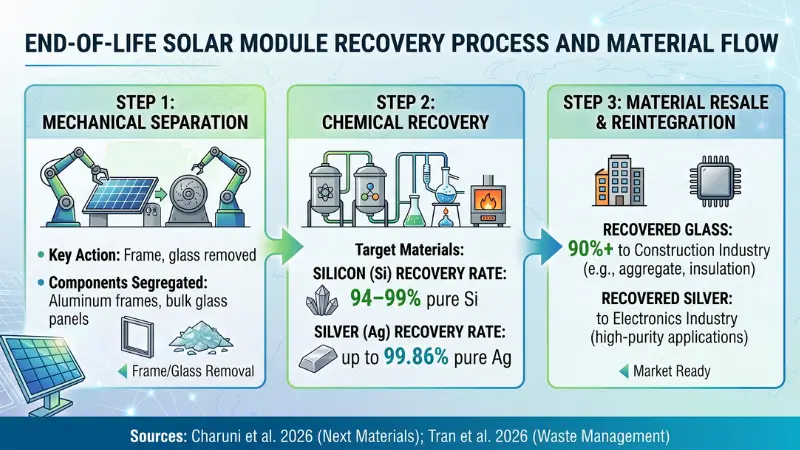
Modern recovery facilities employ a rigorous three-stage protocol to maximize material yield. This industrial pipeline replaces the crude crushing methods of the past with precision extraction, ensuring that PV module recycling contributes to a closed-loop economy rather than a landfill.
Stage 1: Mechanical Separation Automated systems remove the aluminum frame and junction box, then strip the tempered glass from the polymer backing, isolating the silicon cells. This stage eliminates the bulk of the module mass, preparing the remaining concentrated materials for high-precision processing.
Stage 2: Chemical Recovery Facilities use advanced leaching agents and thermal treatments to isolate precious metals. This stage focuses on silicon purification and the extraction of silver, removing hazardous lead and cadmium in the process. According to recent research Tran et al., 2026, these chemical processes now achieve recovery rates of 94-99% for silicon and up to 99.86% for silver.
Stage 3: Material Resale Recovered glass enters the construction sector as high-grade cullet, while purified silver returns to the electronics industry. Research confirms that facilities now recover over 90% of the total glass mass Charuni et al., 2026. This systematic approach allows firms to recycle solar panels while recouping significant costs through commodity sales, transforming decommissioned hardware into a sustainable resource stream.
Selecting the right disposal partner determines whether a project meets current standards or triggers environmental penalties. Installers must distinguish between manufacturer take-back programs and independent third-party recyclers. Take-back programs often include end-of-life clauses in the original purchase contract, requiring the manufacturer to reclaim the hardware. These programs streamline the process but often limit the operator's choice of recovery facility. Conversely, third-party recyclers offer more flexibility and often provide more transparent data on material recovery rates.
The solar panel recycling cost typically ranges from $15 to $40 per panel, depending on the module chemistry and the distance to the nearest facility. This fee covers the labor of decommissioning, hazardous material handling, and the chemical processing required for silver and silicon extraction. While this represents an upfront cost, current regulations view this expense as a necessary risk-mitigation strategy against future landfill taxes and soil contamination lawsuits.
To simplify the search for "solar panel recycling near me," operators should utilize the specialized resources within our solar energy tools directory. This directory provides a filtered database of certified recovery partners and compliance tracking software. The Compliance Audit Tool helps engineers calculate potential landfill penalties, while the Material Value Estimator predicts the rebate value of recovered silver and aluminum based on current market spot prices. Using a certified partner transforms a liability into a documented environmental win.
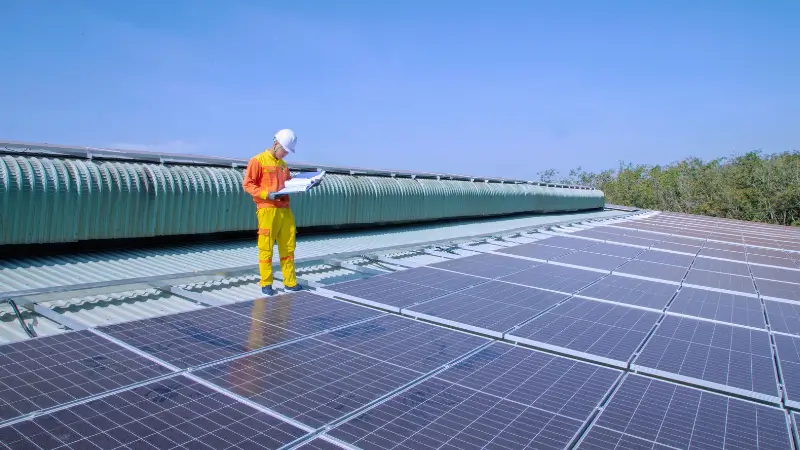
Proactive management of decommissioned hardware prevents legal liabilities and environmental contamination. Solar owners must shift their mindset from simple disposal to strategic asset recovery. Following a strict decommissioning protocol ensures that hazardous materials never enter the local ecosystem and that the owner remains compliant with current mandates.
Owners should execute the following checklist to manage end-of-life modules:
Determining who takes old solar panels requires a verified chain of custody. Owners who skip these steps risk heavy fines. For detailed guidance on navigating regional laws and selecting the right partner, read our comprehensive guide on waste management tools.
The technical data and recovery metrics in this guide rely on the following authoritative sources and 2026 regulatory frameworks:
Charuni, W.K.P.G.N., et al. (2026). "End-of-life solar photovoltaic panels: A review of current recycling methods, material challenges, and emerging environmental threats." Next Materials, 13, 102825. ScienceDirect
Tran, K., et al. (2026). "Recycling of photovoltaic modules: Technologies, comparative insights, challenges, and future outlooks." Waste Management. ScienceDirect
United States Environmental Protection Agency (EPA). "Solar Recycling and Hazardous Waste Management Guide." EPA.gov
International Energy Agency (IEA) PVPS Task 12. "Report on End-of-Life Management of Photovoltaic Systems." IEA-PVPS