Most people think about forest recovery from the canopy down — how tall the trees are growing, how thick the leaves, how fast the canopy closes.
A landmark study published in Nature Communications in January 2026 found that soil nitrogen is one of the most powerful drivers of how quickly a tropical forest recovers after deforestation. Forests with adequate nitrogen rebounded at roughly twice the rate of those lacking it during the first ten years of recovery.
That single finding changes how reforestation projects should be planned, funded, and evaluated. This article explains what the research found, why nitrogen matters so much, and what it means practically for anyone working on or supporting forest restoration.
The Largest Experiment of Its Kind
The research was led by scientists at the University of Leeds, working alongside teams from the University of Glasgow, the Smithsonian Tropical Research Institute, Yale, Princeton, Cornell, the National University of Singapore, and the Cary Institute of Ecosystem Studies.
What made this study different from previous work was its scale. The team designed the largest and longest experiment ever conducted specifically to examine how soil nutrients shape forest regrowth after clearing.
They selected 76 forest plots across Central America — each roughly one third the size of a football pitch — representing forests at different stages of regrowth. Field teams returned to every plot for three months each year, hiking through steep, hot, and humid terrain to apply treatments and record measurements. Some sites were tracked for as long as twenty years.
The experimental design was built to isolate exactly which nutrients made the difference:
-
Some plots received nitrogen fertilizer only
-
Some received phosphorus fertilizer only
-
Some received both nitrogen and phosphorus together
-
Some were left completely untreated as controls
This design allowed the researchers to separate the effects of each nutrient clearly — something previous observational studies could not do.
Lead author Dr Wenguang Tang, who carried out the research while completing his PhD at the University of Leeds, described what the team found in an interview reported by Mongabay: the results were striking enough that they genuinely surprised the scientists running the experiment.
Study co-author Sarah Batterman, an Associate Professor in Leeds' School of Geography and principal investigator, described the finding simply — forests grew back twice as fast in the first decade when they had sufficient nitrogen in the soil. Phosphorus alone showed no comparable effect.
How Soil Nitrogen Forest Recovery From the Ground Up

Nitrogen acts as the fundamental building block for proteins, allowing young trees to develop the leaves and woody tissue necessary to compete for sunlight.
To understand why nitrogen has such a strong effect on young forest recovery, it helps to understand what nitrogen actually does at ground level.
Nitrogen is the essential building block of protein. Trees use it to construct leaves, roots, and woody tissue. Without enough nitrogen in the soil, young trees simply cannot grow fast enough to compete — they are trying to build a structure without sufficient raw material.
In a healthy, undisturbed forest, nitrogen cycles naturally. Trees drop leaves. Leaves decompose. Microbes break down organic matter and return nitrogen to the soil in a form roots can absorb. The system feeds itself continuously.
When a forest is cleared, that entire cycle breaks. The leaf litter disappears. The microbial communities in the soil are disrupted. The organic matter that sustained the nitrogen cycle gets burned, removed, or degraded. What remains is damaged soil that has lost much of its natural fertility.
Young trees trying to regrow on that damaged soil face a nitrogen deficit from their very first day. They grow slowly. The canopy takes longer to close. Carbon capture is delayed. The entire recovery process slows down in ways that are not visible from the surface but are measurable in the data.
The Carbon Connection
This finding matters well beyond tree growth rates. It connects directly to carbon capture — and to whether reforestation projects deliver the climate benefits they promise.
The research team estimated that if nitrogen shortages affect young tropical forests across the globe, approximately 0.69 billion tonnes of carbon dioxide per year may be failing to be stored as a result. That figure is roughly equivalent to two full years of greenhouse gas emissions from the United Kingdom.

The natural alternative to fertilizer: Legume root nodules house bacteria that pull nitrogen directly from the air to fuel forest growth.
That is not a marginal number. It suggests that reforestation projects planted on nitrogen-poor soils are capturing significantly less carbon than their projections predict — which has direct implications for carbon credit accuracy, national climate targets, and the real-world effectiveness of forest-based climate strategies.
Dr Sarah Batterman put the practical implications clearly: avoiding deforestation of mature tropical forests should always be the first priority, but understanding how nutrients affect carbon sequestration is essential for policymakers deciding where and how to restore forests to maximize climate benefit.
Soil quality is not background noise in reforestation. It is an active variable that determines how much carbon a restored forest actually removes from the atmosphere.
Why Young Forests Are Most Vulnerable
One of the most important details in this research is the age dependency of nitrogen limitation.
The nitrogen effect was strongest in plots representing recently abandoned pasture and young forests in the first ten years of recovery. In middle-aged forests — around ten to thirty years old — the boost from nitrogen declined noticeably. In mature forests that had remained undisturbed for centuries, nitrogen addition showed no significant effect at all.
This tells us exactly where the bottleneck sits.
Mature forests have spent decades rebuilding their organic soil layer, their microbial communities, and their natural nutrient cycles. They are largely self-sufficient systems that no longer depend on external nitrogen inputs.
Young forests on recently cleared land are at their most vulnerable point. They are growing on damaged soil without the biological infrastructure that a mature forest has built over generations. They need nitrogen most urgently precisely when the soil has the least of it to offer.
This is the critical window. Get soil nitrogen right in the first decade and a recovering forest can progress at twice the normal speed. Miss that window and the recovery stalls in ways that take many additional years to reverse.

Soil nitrogen deficiency can cut carbon sequestration in half, leading to a global shortfall of nearly $0.69$ billion tonnes of $CO_2$ storage annually.
Two Practical Solutions the Research Recommends
The study is careful about what it does and does not recommend. The researchers used nitrogen fertilizer in the experiment but explicitly advise against applying it at scale in reforestation projects. Adding synthetic fertilizer to forests can trigger increased emissions of nitrous oxide — a greenhouse gas significantly more potent than carbon dioxide — which would undermine the very climate benefits reforestation is supposed to deliver.
Instead, the research points toward two approaches that work with natural systems:
Plant nitrogen-fixing trees as natural "fertiliser factories"

he tangible result: Rich, dark soil structure is a hallmark of healthy nitrogen cycling. By using nitrogen-fixing legumes as "natural factories," projects can build this nutrient-dense foundation without synthetic inputs. (Image: [United Soybean Board](https://commons.wikimedia.org/wiki/File:Soybean_Field_with_Healthy_Soil_(9316804120).jpg)
/ [CC BY 2.0](https://creativecommons.org/licenses/by/2.0/))
Trees from the legume — or bean — family possess a remarkable biological advantage. Their roots forge a symbiotic alliance with soil bacteria, pulling nitrogen directly from the atmosphere and "fixing" it into the earth. By weaving legume species into a reforestation mix, a project builds its own self-sustaining nitrogen supply, eliminating the need for synthetic chemicals.
These species are the heavy-lifters of tropical recovery. Jefferson Hall, director of the Agua Salud Project at the Smithsonian Tropical Research Institute, notes that restoring this natural cycle is the only sustainable path forward. It’s not just about planting trees; it’s about rebooting the soil’s internal engine.
Prioritize restoration in areas with naturally sufficient nitrogen.
Not all degraded land is equally nitrogen-depleted. In areas where atmospheric nitrogen deposition from agriculture and industry has raised soil nitrogen levels over time, young forests may already have access to the nitrogen they need for faster recovery.
This is counterintuitive — air pollution is rarely considered a resource — but the research suggests it is a genuinely practical factor when deciding where to prioritize restoration efforts for maximum carbon benefit.
What Reforestation Projects Should Do Differently
This research supports several concrete changes in how serious reforestation programs are designed and evaluated:
-
Test soil nitrogen before planting begins. Understanding the nitrogen status of a site before the first tree goes in the ground should become standard practice. A site that looks suitable above ground may be severely nitrogen-limited below it.
-
Include legume species in every planting mix. A species selection that includes nitrogen-fixing trees is not just more biodiverse — it actively builds the soil conditions that accelerate recovery across the entire planting site.
-
Adjust carbon projections for sites with nitrogen-poor soil. If nitrogen-limited soils produce significantly slower carbon capture, then projections built on average growth rate assumptions will systematically overstate the climate benefits of projects on degraded land.
-
Add below-ground monitoring alongside above-ground tracking. Most reforestation monitoring measures canopy height and tree survival. Adding soil nutrient testing — particularly nitrogen levels — gives a far more accurate picture of how a forest is actually recovering and how much carbon it is genuinely storing.
-
Treat the first decade as the highest-leverage window. Since nitrogen limitation is strongest in young forests, the first ten years after planting are where soil management decisions produce the largest long-term compounding benefits.
What This Means for Carbon Credits
If you support reforestation projects through carbon credits or donations, this research raises a question worth asking directly: does the project account for soil nitrogen conditions in its carbon projections?
Most current carbon credit methodologies use growth rate assumptions that may not reflect the reality of nitrogen-depleted soils. Richard Birdsey, a senior scientist at the Woodwell Climate Research Center who was not involved in the study, noted that nutrient loss in tropical forests has long been recognized — but much of that understanding previously came from observation rather than the kind of controlled experimental evidence this study now provides.
That gap between observation and controlled evidence matters for credit integrity. A project planted on nitrogen-poor degraded land could be systematically over-crediting its carbon removal — promising outcomes its soil conditions cannot support.
Verification standards are beginning to engage with this. Verra's updated VCS methodology incorporates more detailed site assessment requirements, and the 2025 and 2026 updates push for more granular monitoring data. But soil nutrient testing is not yet a universal requirement across all standards.
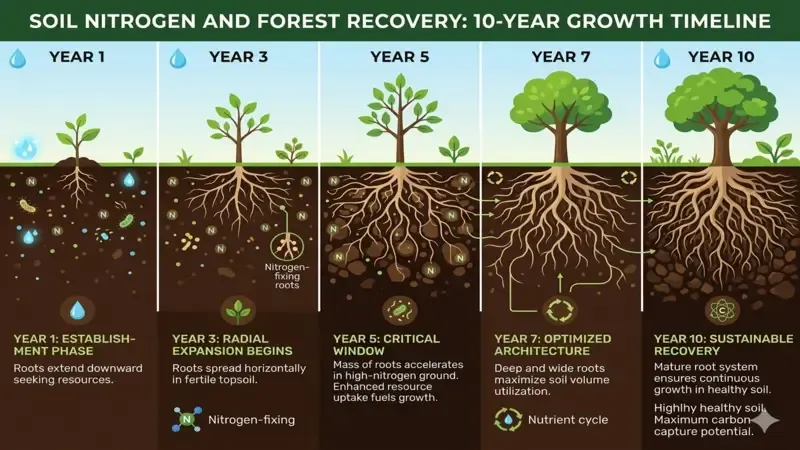
The first decade is the "make or break" period where nitrogen availability determines the long-term trajectory of the forest.
Asking whether a project has assessed soil nitrogen is now a reasonable and well-informed question for any serious donor or carbon buyer to raise. To understand how the full verification process works, read our guide on how tree-planting projects are verified.
A Forest Starts Below the Ground
This research fits into a larger shift happening in reforestation science right now.
For years the dominant conversation focused on tree counts — how many trees planted, where, and how fast they grew. Those questions still matter.
But the evidence is increasingly pointing below the surface. Soil health, microbial communities, nutrient cycles, and below-ground carbon storage are proving to be just as important as what happens in the canopy above.
A forest is not just trees. It is an entire living system that extends meters below the ground — a system that took centuries to build and can be degraded in a single season of clearing.
Restoring that below-ground system is not a technical footnote to reforestation. It is part of the work itself.
Understanding the reforestation benefits that well-managed projects deliver — and the difference between projects that account for soil health versus those that do not — matters deeply for anyone wanting their support to produce genuine long-term results. If you are new to this topic, start with what reforestation actually means before exploring the science in more depth.