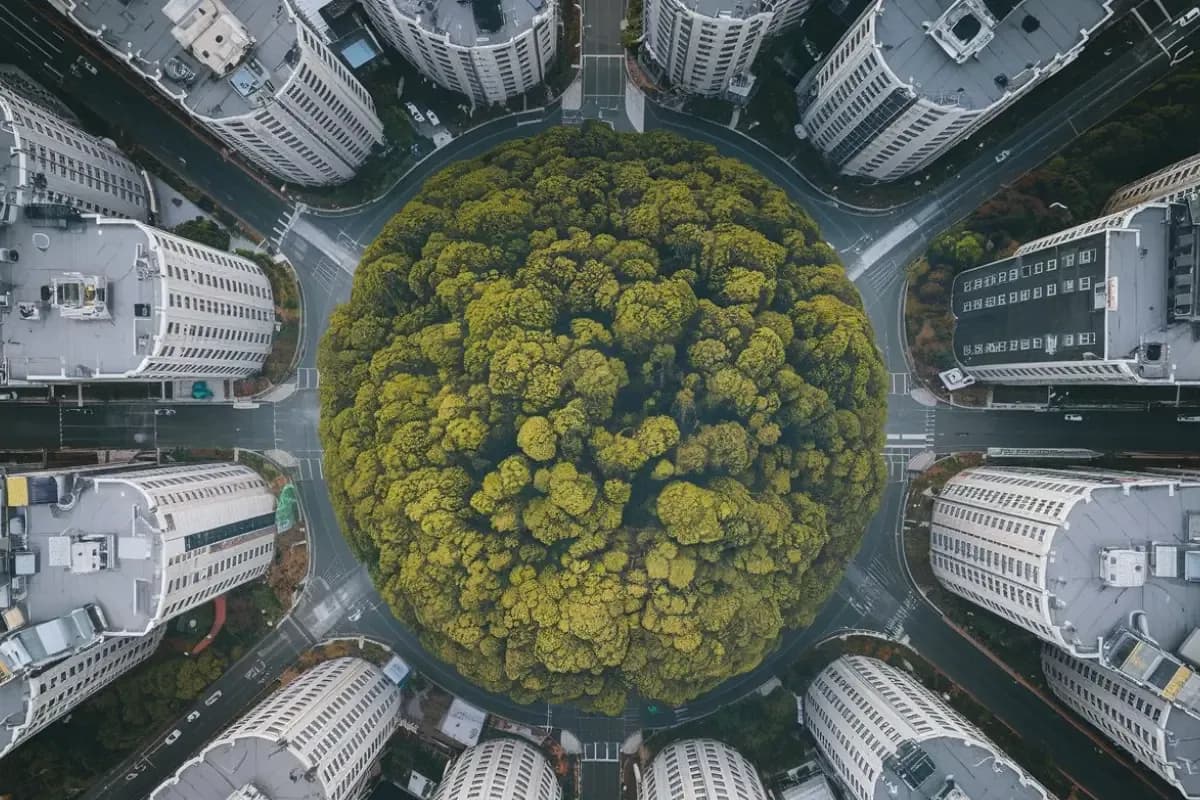
Most people picture a forest as something vast, ancient, and centuries in the making.
Dr. Akira Miyawaki saw it differently.
He believed a dense, thriving, genuinely wild forest could grow in the space of a tennis court — on a school playground, a parking lot, or a strip of degraded urban land — and do it in decades, not centuries.
He spent his life proving it. And in 2026, his method is spreading across six continents, one small patch of ground at a time.
This guide explains what the Miyawaki method mini forest actually is, how it works step by step, where it is producing real results right now, and what honest limitations you should understand before starting one yourself.
The Japanese Botanist Who Started It All
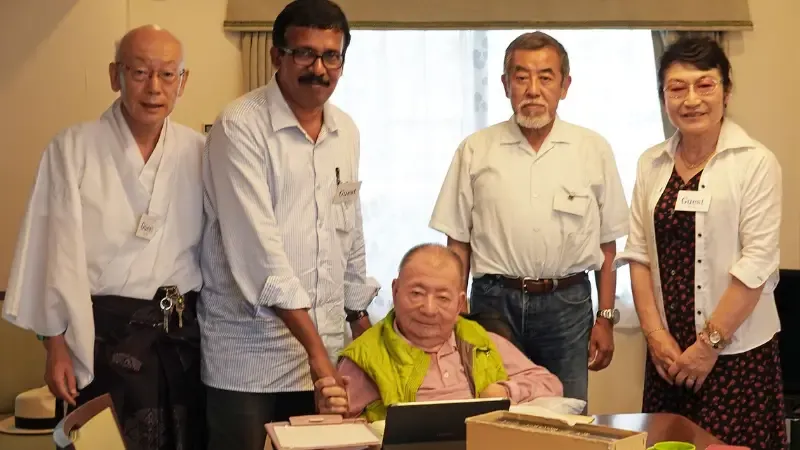
Prof. Akira Miyawaki, seated center, with colleagues at a research meeting. He spent decades mapping over 10,000 shrine forests across Japan before developing the method that now bears his name.
Photo: Wikimedia Commons — CC BY-SA 4.0 — Prof. Akira Miyawaki with Mr. Kiyokazu Kasayama, M.R. Hari, Prof. Kouto Nakamura, and Prof. Kazue Fujiwara.
Akira Miyawaki was born in 1928 in a small Japanese farming village. He grew up watching how wild plants organized themselves naturally — without any human plan or interference.
His most important discovery came from an unexpected place.
While most of Japan's landscape had been cleared, logged, or farmed over centuries, the sacred grove forests surrounding Shinto shrines and Buddhist temples had been left completely untouched for generations. Nobody cut them. Nobody managed them. They just grew.
Miyawaki realized these groves were living blueprints. They showed exactly what native Japanese forest looked like before human activity changed everything — densely layered, species-rich, self-sustaining.
He spent years mapping over 10,000 of these shrine forests across Japan. That research became the scientific foundation of everything that followed.
Before Miyawaki passed away in 2021, he personally led planting at more than 2,500 sites in Japan and 150 more internationally — putting over 40 million trees into the ground across his lifetime.
What the Method Actually Does for Miyawaki
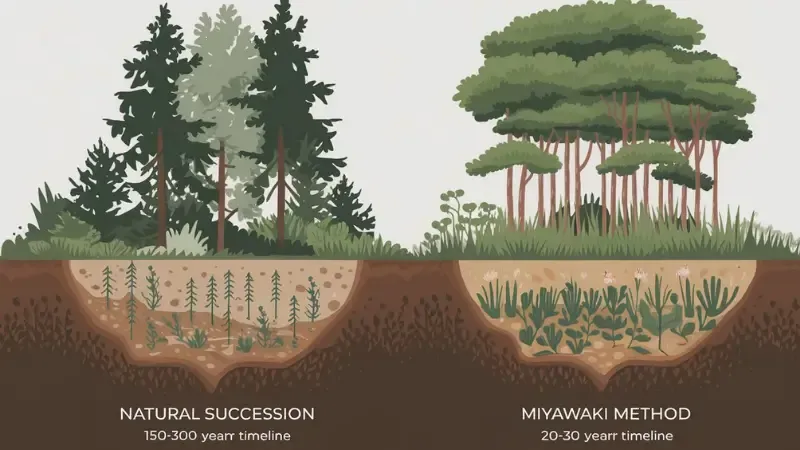
Natural succession takes centuries. The Miyawaki method plants the endpoint from day one.
The Miyawaki method creates dense, multi-layered native forests on degraded land — fast.
It does this by skipping the slow, step-by-step process that natural forests normally follow. In undisturbed nature, forests develop in stages over centuries. Pioneer plants arrive first. Then shrubs. Then small trees. Then large ones. A full climax forest — the mature, stable endpoint of this process — can take 150 to 300 years to establish naturally.
Miyawaki's approach cuts straight to the end.
Instead of starting with pioneer plants and waiting for nature to move through each stage, the method plants a carefully selected mix of native climax species — the trees that would eventually dominate a mature forest in that specific location — all at once, at high density, into properly prepared soil.
The trees compete intensely for light from their very first year. That competition is deliberate. It drives faster upward growth, builds a protective canopy quickly, and creates the cool, humid interior microclimate that makes a mature forest self-sustaining.
According to research on the method, trees in Miyawaki forests grow at roughly three times the rate of conventional plantings — faster than standard methods, though some of the more extreme claims of ten times faster growth are not well supported by current scientific evidence.
After three years of active care — watering, weeding, and mulching — the forest closes its canopy and becomes entirely self-sustaining. No maintenance needed after that point.
How to Build One — The Actual Steps
The process has four stages. Each one matters. Skipping any of them produces poor results.
Start With the Right Species, Not a Generic List
Before a single sapling goes in the ground, practitioners study the local ecology carefully.
The goal is to identify what tree species would naturally grow in that exact location if humans had never disturbed it. Miyawaki called this the "potential natural vegetation" of a site.
This is not guesswork and it is not a standard list you download from the internet. It involves studying local climate data, existing wild plant communities, historical land records, and — wherever possible — visiting any remaining patches of undisturbed native woodland nearby.
Getting species selection right is the single most important decision in the entire process. A Miyawaki forest planted with the wrong species will struggle from day one. One planted with the right native mix will practically raise itself.
Prepare the Soil Before Anything Else
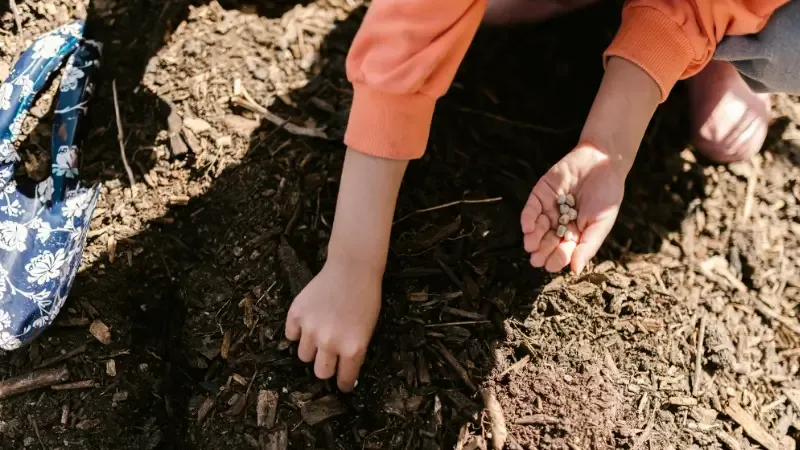
The most expensive and non-negotiable stage. Poor soil preparation guarantees poor results — no matter how good the species selection.
Most urban and degraded land has compacted, nutrient-poor soil — damaged by years of construction, agriculture, or neglect.
The soil gets dug to a depth of around 60 to 100 centimeters and enriched with locally available organic material. Compost, rice husks, wood chips, and straw are all commonly used depending on what the region produces naturally.
This stage is the most expensive and labor-intensive part of the entire project. It is also the part most people want to skip. Skipping it almost guarantees failure. No amount of careful planting compensates for poor soil preparation.
Plant Densely — Much More Densely Than Feels Natural
Conventional tree plantations space trees wide apart — giving each one room to grow without competing with neighbors.
The Miyawaki method does the opposite. Saplings go in at two to four plants per square meter. That is far tighter than any standard forestry approach would recommend.
The dense planting mimics exactly what happens when a gap opens up in a natural forest canopy — dozens of young trees race upward together, fighting for light. The strongest form the canopy. The rest fill the understory and ground layer. Every plant has a role.
This competition is what drives the faster growth that makes Miyawaki forests distinct from conventional plantations.
Care for Three Years, Then Step Back
For the first two to three years, the young forest needs real attention.
Regular watering during dry spells. Removing invasive weeds that compete with young saplings. Adding fresh mulch to hold moisture and keep weeds down naturally.
This phase works best as a community effort. Many of the most successful Miyawaki projects run on volunteer energy — neighbors, school groups, and local organizations sharing the work together across the early growth period.
After roughly three years, the canopy closes over. The forest becomes self-shading and self-sustaining. Human maintenance stops entirely at that point. The forest takes over.
Where Real Miyawaki Forests Are Growing Right Now
The method has moved well beyond Japan. Here is where it is actively producing results in 2026.
France
In Lyon, volunteer organization Boomforest planted a Miyawaki mini forest that grew to over ten feet tall within just three years — creating a visible green oasis during summer heat waves on land that had previously been bare and dry.
Boomforest now maintains more than 20 mini forests across France, with similar organizations running comparable projects in Belgium, the Netherlands, and Germany. The public voted to fund the very first one through a participatory budgeting exercise in Paris — which tells you something important about how these projects build community ownership.
United States
The mini forest movement gained serious momentum across the US in the past five years.
On October 4, 2025, more than 275 volunteers gathered to plant 1,400 native trees and shrubs across a 3,000 square-foot site in front of Belmont High School in Massachusetts — one of at least 20 Miyawaki-style plantings now established across the state, as reported by Science Friday.
There are now at least 20 Miyawaki-style plantings in Massachusetts alone, with dozens more across the country. The first US plantings were led by Miyawaki himself in 2014 on industrial sites in Indiana and Kentucky.
Canada
Green Communities Canada launched its National Mini Forest Pilot in 2022 in partnership with the Network of Nature, planting 15 sites across five provinces in the first year alone and scaling further through 2024 and 2025 with support from Natural Resources Canada's Two Billion Trees program.
Their National Mini Forest Pilot is actively building evidence on soil carbon benefits and long-term ecological outcomes across different Canadian climate zones — generating the kind of rigorous data that researchers say the method still needs more of.
India
Shubhendu Sharma attended one of Miyawaki's presentations in 2009 as a Toyota engineer.
He quit his job shortly after and founded Afforestt — a company that has since planted over 450,000 trees across 144 mini forests in 50 cities worldwide. His 2014 TED Talk introduced the Miyawaki method to a global audience and sparked a wave of urban mini forest projects that continues today.
Sharma documented something striking from his very own backyard forest in India. Monsoon rain that previously pooled and ran off the surface of his yard began absorbing completely into the soil within one year of establishing his first planting. Twelve species of birds moved in within the first year.
Japan and Southeast Asia
Japan remains home to the oldest and largest Miyawaki forests. Over 1,300 restoration sites were documented during Miyawaki's lifetime.
In Southeast Asia, the method has been applied for tsunami protection planting, mine site rehabilitation, and typhoon shelterbelts — practical structural uses that go far beyond urban greening and demonstrate real ecological value in difficult conditions.
What a Miyawaki Forest Actually Delivers
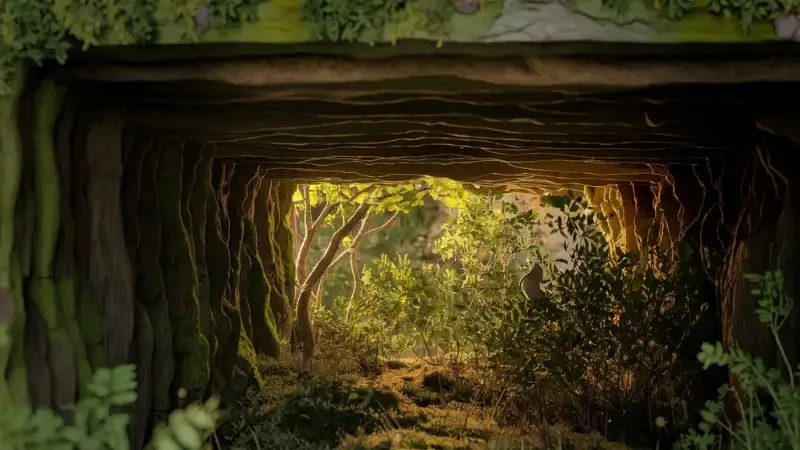
Three years after planting the canopy closes and wildlife moves in. Birds, insects, and soil organisms respond to the layered complexity that a single-species plantation never produces.
The benefits are real. But they deserve an honest description rather than the most optimistic numbers available.
Biodiversity is genuinely higher than in monoculture plantations. The multi-layered structure — canopy trees, understory trees, shrubs, and ground herbs all growing together — creates far more ecological niches than a single-species plantation ever produces. Birds, insects, and soil organisms all respond to that complexity.
Urban temperature reduction is measurable. Miyawaki forests reduce local air temperatures by 1 to 5 degrees Celsius depending on size and location. In cities dealing with urban heat islands, that reduction has direct consequences for human health during summer heat waves.
Carbon capture begins faster than in conventional plantings. Dense early biomass growth means carbon sequestration starts meaningfully within a few years rather than the decades a conventional plantation needs to reach comparable growth.
Rainwater management improves significantly. Dense root systems and rich organic soil absorb and filter rainfall instead of letting it run straight into drainage systems. This reduces flood risk locally and improves groundwater quality downstream.
What the Research Actually Says — The Honest Words
A 2026 study published in the Journal of Applied Ecology reviewed 51 scientific documents on the Miyawaki method and reached some important conclusions.
Reported outcomes offered weak to null evidence for most claimed benefits, including rapid growth, accelerated succession, self-sustainability, cost efficiency, enhanced biodiversity, higher carbon sequestration, and increased tree density. ScienceDaily
That is a significant finding and worth taking seriously.
The researchers were not saying the method does not work. They were saying the evidence base behind the most ambitious claims is thinner than the method's popularity would suggest, particularly outside Japan's specific climate and ecology.
The study recommended that practitioners prioritize methods backed by robust empirical evidence and called for more rigorous experimental designs and transparent reporting going forward.
A separate critical analysis noted that while trees in Miyawaki forests do grow faster than conventional plantings, the commonly cited claim of ten times faster growth is not supported by the data. A more realistic figure based on Miyawaki's own writing is closer to two to three times faster — still meaningful, but worth stating accurately.
High upfront costs are also a genuine barrier. Soil preparation is expensive. For community groups or local authorities with limited budgets, that cost makes the method inaccessible without dedicated funding or significant volunteer labor.
The method also does not suit every site. It works best on degraded land where native forest once grew naturally. Applying it to open grasslands, wetlands, or other non-forest habitats can actually reduce biodiversity rather than improve it.
None of this invalidates the Miyawaki method. It focuses the conversation on where the method works best and where the evidence is strongest — which is exactly what serious environmental work requires.
How It Compares to a Conventional Plantation
A conventional plantation plants one or two species in rows, optimized for timber or carbon credit production. It is predictable, manageable, and financially straightforward.
Ecologically, it functions almost like a desert. Few birds nest there. Few insects thrive. The soil beneath a monoculture plantation is often in worse condition after planting than before.
A Miyawaki forest is deliberately the opposite. Dense, layered, species-rich, and built to function as a genuine living ecosystem — cleaning air, absorbing water, cooling its surroundings, sheltering wildlife, and sustaining itself without any ongoing management once established.
The real tradeoff is higher upfront cost and complexity, exchanged for ecological richness and permanent self-sufficiency over time. Neither approach is universally better. They serve different purposes on different land.
How to Start a Miyawaki Forest in Your Community
You do not need a large budget or a professional forestry team to start a Miyawaki mini forest.
What you need is careful planning, the right native species, properly prepared soil, and three years of genuine community commitment.
The minimum viable size is smaller than most people expect. An area of 50 to 100 square meters — roughly the footprint of a large family garden — can support a proper Miyawaki mini forest with dozens of native species. Schoolyards, corporate grounds, urban parks, roadsides, and community gardens have all been used successfully.
Organizations like Earthwatch Europe in the UK, Afforestt in India, and Green Communities Canada provide direct guidance and resources for community groups wanting to start their own project.
The most important first step is local research. Find out exactly which native tree species belong in your specific location. Talk to local botanists or ecologists. Study any remaining patches of natural woodland nearby.
A Miyawaki forest built on genuine local knowledge will always outperform one built from a generic downloaded planting list. That principle sits at the very heart of what Miyawaki spent his career teaching.
Miyawaki Forests and Carbon Credit Verification
A practical question worth answering directly — do Miyawaki forests qualify for carbon credits?
Yes, under the right conditions.
A Miyawaki mini forest planted on degraded land, monitored properly, and registered with a recognized standard like Verra's VCS or the Gold Standard can generate legitimate carbon credits. The dense early biomass growth and measurable biodiversity outcomes make well-managed Miyawaki projects strong candidates for formal verification.
The project must follow the required protocols from the very beginning — documentation, monitoring, and reporting all need to be in place before planting starts, not added afterward.
To understand exactly how that verification process works in practice, read our full guide on how tree-planting projects are verified.
A Small Forest With a Long Reach
The Miyawaki method does not promise to solve the entire global deforestation crisis on its own.
What it does offer is something genuinely valuable — a working forest within reach of any community that has a patch of degraded land, willing hands, and three years of patience.
The real power of the method is not in any single mini forest. It is in thousands of them growing simultaneously — in cities, on school grounds, on industrial sites, along roadsides — each one cooling its neighborhood, feeding insects, sheltering birds, filtering rain, and pulling carbon from the air.
That is not a small contribution. That is how meaningful ecological restoration actually spreads — not through one enormous project, but through countless small ones, each rooted in local knowledge and community care.
Want to understand the wider picture of what reforestation delivers for communities and ecosystems? Read our guide on reforestation benefits in 2026. And if you are new to this topic entirely, start with what reforestation actually means before exploring specific methods like this one.